Smoking Billboard
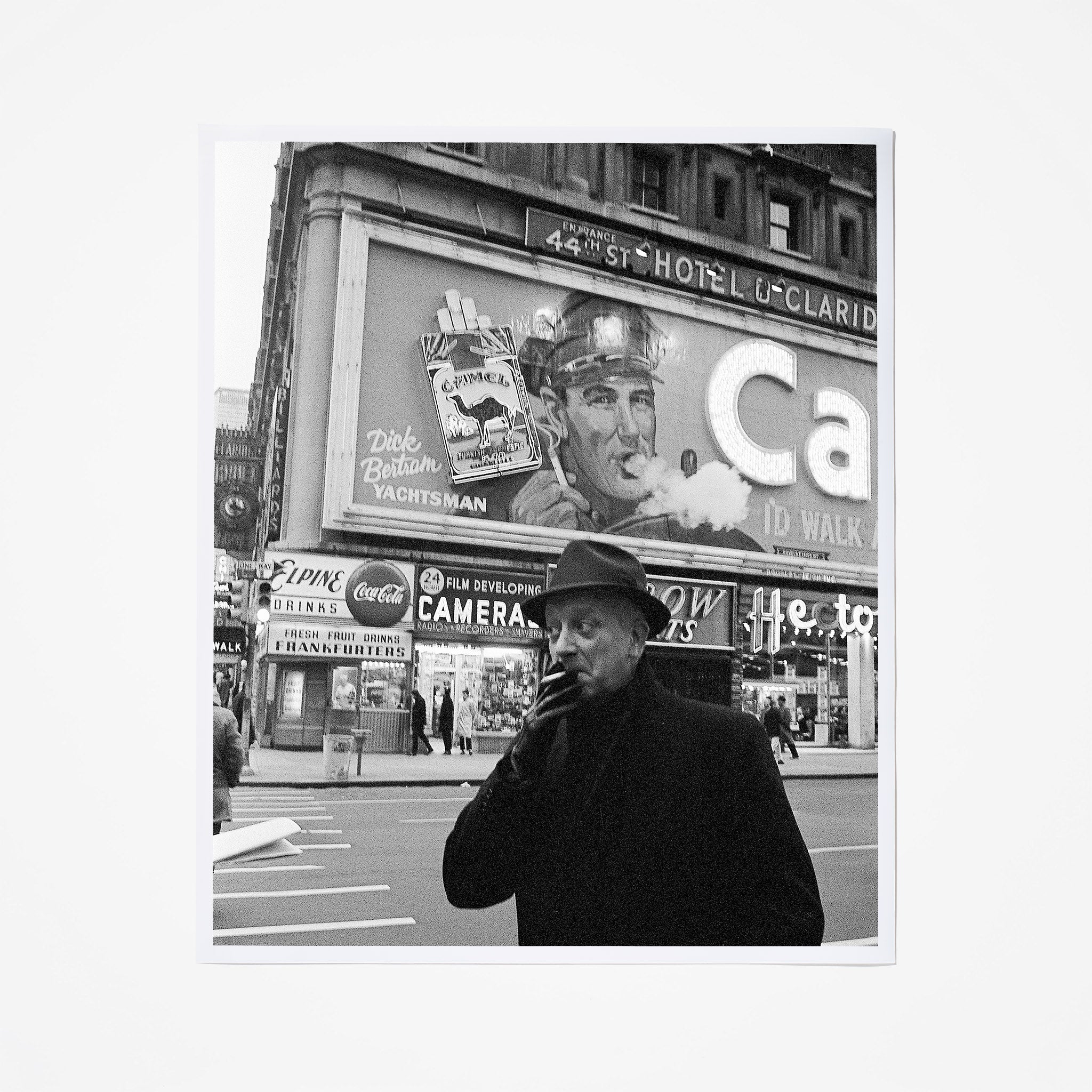
The landmark Camel sign blew its last oversized puff of smoke in Times Square more than 50 years ago. The two-story sign had been "smoking" since a few days after the attack on Pearl Harbor.
During World War II, the model morphed from sailor to soldier to marine to airman and back again, every four months, The New York Times reported. But in 1966, RJ Reynolds Tobacco Company decided that the iconic puffing billboard had done its work. The company's advertising agency told The Times that the change had nothing to do with cancer warnings or the increase in popularity of filtered cigarettes. "We're just always looking for ways to support other forms of advertising," a spokesman said at the time. Times photographer Eddie Hausner took this unpublished photo as a Times reporter spoke with Kjell Lindell, a maitre d' who admitted to smoking about three cigarettes a day.
The landmark Camel sign blew its last oversized puff of smoke in Times Square more than 50 years ago. The two-story sign had been "smoking" since a few days after the attack on Pearl Harbor.
During World War II, the model morphed from sailor to soldier to marine to airman and back again, every four months, The New York Times reported. But in 1966, RJ Reynolds Tobacco Company decided that the iconic puffing billboard had done its work. The company's advertising agency told The Times that the change had nothing to do with cancer warnings or the increase in popularity of filtered cigarettes. "We're just always looking for ways to support other forms of advertising," a spokesman said at the time. Times photographer Eddie Hausner took this unpublished photo as a Times reporter spoke with Kjell Lindell, a maitre d' who admitted to smoking about three cigarettes a day.
Original: $50.00
-65%$50.00
$17.50Description
The landmark Camel sign blew its last oversized puff of smoke in Times Square more than 50 years ago. The two-story sign had been "smoking" since a few days after the attack on Pearl Harbor.
During World War II, the model morphed from sailor to soldier to marine to airman and back again, every four months, The New York Times reported. But in 1966, RJ Reynolds Tobacco Company decided that the iconic puffing billboard had done its work. The company's advertising agency told The Times that the change had nothing to do with cancer warnings or the increase in popularity of filtered cigarettes. "We're just always looking for ways to support other forms of advertising," a spokesman said at the time. Times photographer Eddie Hausner took this unpublished photo as a Times reporter spoke with Kjell Lindell, a maitre d' who admitted to smoking about three cigarettes a day.